Anchor sector
Oilfield services & equipment
Well workovers, EOR, pipeline repair and terminal upgrades as NOC works to raise sustained output.

 Profile content in preparation
Africa's largest oil reserves, rebuilding.
Holder of the largest proven oil reserves in Africa, with 1,770 km of Mediterranean coastline and a national reconstruction agenda across power, housing and infrastructure.
Statistics year: 2024 (latest full-year estimates)
Libyan macroeconomic reporting is incomplete and output swings sharply with oil field and export terminal availability. Figures shown are the latest verified international estimates rather than audited national accounts.
Libya holds roughly 48 billion barrels of proven oil reserves — the largest in Africa — along with substantial natural gas, and its light sweet crude is prized by Mediterranean refiners.
Years of disruption left major gaps in electricity generation, water infrastructure, housing and healthcare, creating a broad reconstruction agenda funded largely by hydrocarbon revenue.
American companies have a long history in Libyan upstream operations, and the National Oil Corporation continues to seek international partners to raise production capacity.
Oil dominates exports and public revenue; reconstruction spending is the main channel through which that revenue reaches other sectors.
The largest in Africa
With a stated target above 2M bpd
Concentrated along the coast
Mediterranean, close to European markets
Where Libyan institutions and contractors are actively procuring.
Well workovers, EOR, pipeline repair and terminal upgrades as NOC works to raise sustained output.
New gas-fired capacity, transmission rehabilitation and distribution upgrades to end chronic outages.
Large residential and municipal reconstruction programmes, particularly in the east.
Maintenance of the Great Man-Made River system plus new coastal desalination capacity.
Hospital rebuilding, diagnostics, and medical supply contracts.
Airport terminal reconstruction and port handling equipment procurement.
Libya's near-term agenda centres on stabilising oil production, restoring the electricity network and rebuilding damaged cities and infrastructure.
Export terminals reopen and output recovers above one million barrels per day.
A stated goal of raising production capacity to more than two million barrels per day.
Dedicated reconstruction budgets established for damaged eastern cities.
Sustained higher oil output and a substantially rebuilt power and water network.
Programmes driving equipment and engineering procurement.
Field redevelopment and pipeline work aimed at a sustained increase in export capacity.
New combined-cycle plants and rehabilitation of existing generation and transmission.
Rebuilding housing, bridges, dams and public facilities after flood damage.
Repair and extension of the world's largest irrigation and water-transfer project.
Terminal rebuilding at Tripoli and Benghazi to restore international capacity.
Libyan crude flows mainly to Mediterranean refiners, while American oilfield technology, machinery and agricultural commodities move the other way.
Verified full-year bilateral merchandise trade between Libya and the United States, reported from Libya's perspective.
Latest verified data available
Libya's goods trade with the United States is driven by crude petroleum shipments, giving it a surplus, while American exports focus on oilfield and industrial equipment. Volumes remain volatile with production and security conditions.
Latest verified data available; annual volumes fluctuate significantly with oil production and export terminal availability. These figures represent merchandise trade only and do not include services.
Statistical year: 2024
Some of the finest classical archaeology anywhere on the Mediterranean, plus Saharan landscapes.
One of the most spectacular Roman cities surviving anywhere in the world.
A Phoenician trading post with a magnificent seafront Roman theatre.
A major ancient Greek colony in the eastern highlands.
An oasis town of covered streets known as the pearl of the desert.
An Ottoman walled city with the Marcus Aurelius arch at its edge.
Reserves, revenue and reconstruction demand, for companies with the right partner structure.
The largest proven oil reserves in Africa with low extraction costs.
Nearly all food, equipment and consumer goods are imported, favouring supply partnerships.
Short Mediterranean shipping routes to major European markets.
Reconstruction and energy spending backed directly by export revenue.
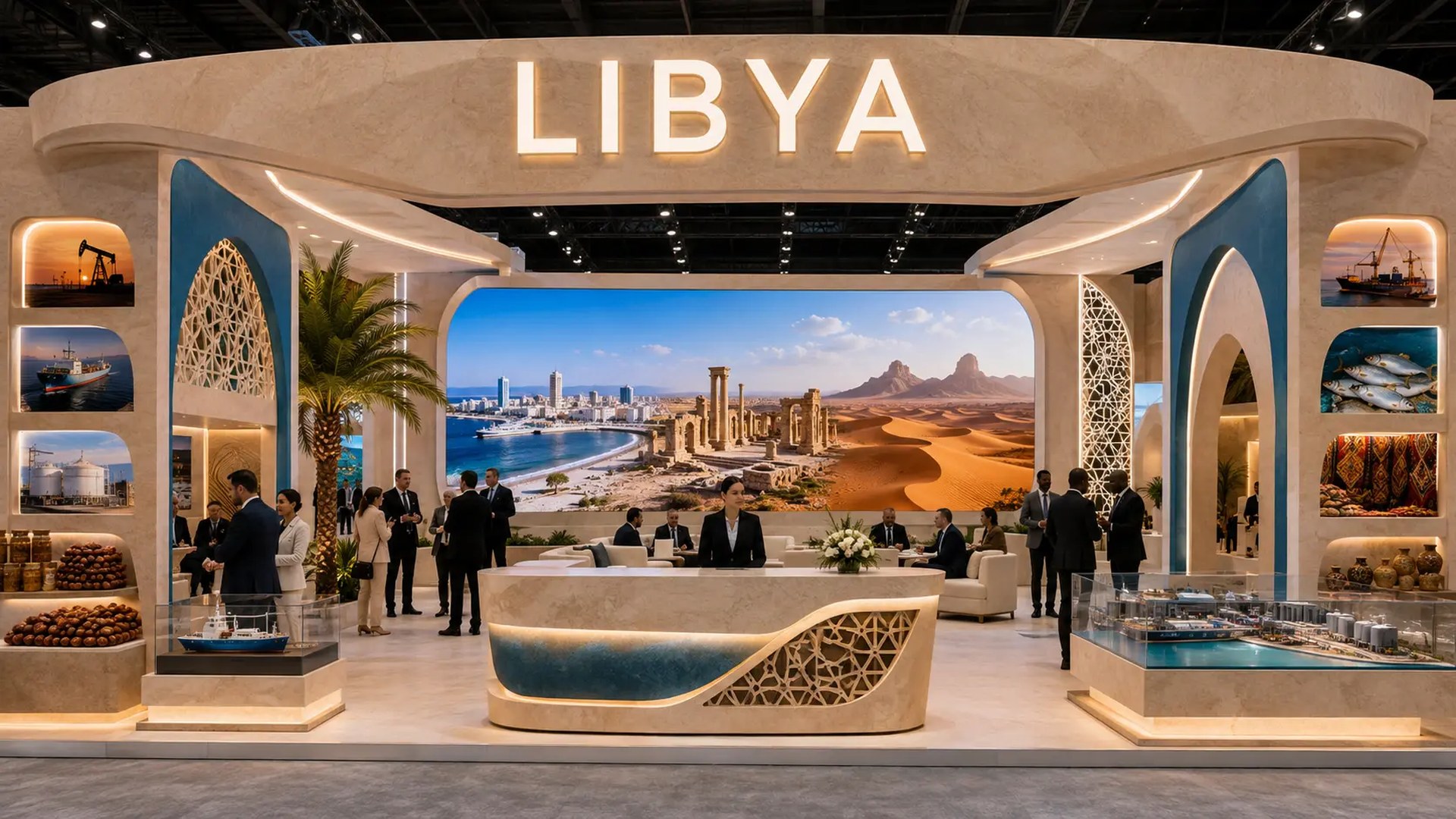
The Libya pavilion connects reconstruction and energy buyers with American engineering and equipment suppliers.
Sites inscribed on the UNESCO World Heritage List, a core part of the country's cultural and tourism offer.
The birthplace of Emperor Septimius Severus and a monumental Roman port city.
A Roman coastal city with an exceptional three-storey theatre.
One of the principal cities of the Hellenic world.
A traditional Saharan oasis settlement of covered passages and rooftop streets.
Thousands of prehistoric paintings and carvings in the southwestern desert.
How companies from different markets can engage with Libya through the Expo.
Oilfield services, power generation equipment, water technology and medical supply contracts with NOC, GECOL and reconstruction authorities.
Construction, building materials, food distribution and logistics into a heavily import-dependent market.
Upstream partnership, refinery and petrochemical rehabilitation and long-horizon infrastructure concessions.
Present your country's economy, industries, products, investment opportunities, tourism destinations and culture to the American and North American markets.
Reserve space in the Libyan pavilion, or register as an American supplier to meet Libyan buyers, contractors and energy institutions.
Last updated: August 2026