Priority
Power generation & grid
Gas-fired generation, transmission upgrades and solar tenders aimed at closing a persistent supply gap.
 Profile content in preparation
Reconstruction at national scale.
OPEC's second-largest producer, with a 40-million-person consumer market and one of the largest reconstruction and infrastructure programs in the world.
Statistics year: 2024 (latest full-year estimates)
Iraqi statistical reporting is improving but remains partial in some sectors; figures are the latest verified international estimates.
Iraq is the second-largest oil producer in OPEC and one of the largest markets in the Arab world by population, with an overwhelmingly young consumer base.
Reconstruction spans electricity generation and transmission, housing, water, roads, hospitals, schools and telecoms — much of it financed by oil revenue and executed through international contractors.
American energy majors, engineering firms and equipment suppliers already hold significant positions, and the government continues to court US technology and services partners.
Hydrocarbons dominate exports, but the spending they fund flows into construction, power, transport and consumer sectors.
Among the largest Arab economies
Second-largest in OPEC
A very young consumer market
Across infrastructure sectors
Sectors where ministries, provincial governments and private groups actively seek international suppliers.
Gas-fired generation, transmission upgrades and solar tenders aimed at closing a persistent supply gap.
Field development, gas capture, water injection and maintenance contracts across southern Iraq.
Large residential programs plus schools, hospitals and municipal infrastructure.
Treatment, desalination and irrigation projects addressing severe water stress.
Mechanization, seed technology and food processing across a large farming base.
Fibre rollout, data centers, banking digitization and payment infrastructure.
Iraq's development plans prioritise electricity, gas capture, housing and transport corridors that reconnect the country to regional trade.
International pledges mobilised for post-conflict rebuilding.
Major agreements to stop flaring and feed domestic power generation.
A rail and road corridor plan linking the Gulf to Türkiye and Europe.
Reliable national power supply and a substantially rebuilt transport network.
Programs of a size that require international engineering, equipment and finance.
A deep-water port on the Gulf designed to become one of the largest in the region.
A planned 1,200 km rail and highway corridor from Faw to the Turkish border.
Multi-billion-dollar programs to capture associated gas and convert it into domestic electricity.
Large planned residential cities around Baghdad and provincial capitals.
Iraq is a significant source of US crude imports, while American machinery, vehicles and agricultural products flow the other way.
Verified full-year bilateral merchandise trade between Iraq and the United States, reported from Iraq's perspective.
Iraq records a large goods surplus with the United States because crude petroleum dominates its shipments, while American exports concentrate on vehicles, power and industrial equipment supporting reconstruction and electricity capacity.
These figures represent merchandise trade only and do not include services.
Statistical year: 2024
Mesopotamian heritage, religious pilgrimage and a mountainous north.
The ancient Mesopotamian capital, a UNESCO World Heritage site.
One of the world's oldest continuously inhabited settlements.
Pilgrimage cities receiving millions of visitors each year.
Scale and need, for companies with the right partner and risk framework.
Roughly 45 million people with rising consumption and unmet infrastructure demand.
Capital programs financed directly from export revenue rather than external debt alone.
Established American presence in energy, engineering, aviation and agriculture.
Land routes connecting the Gulf, Türkiye, Jordan and Iran.
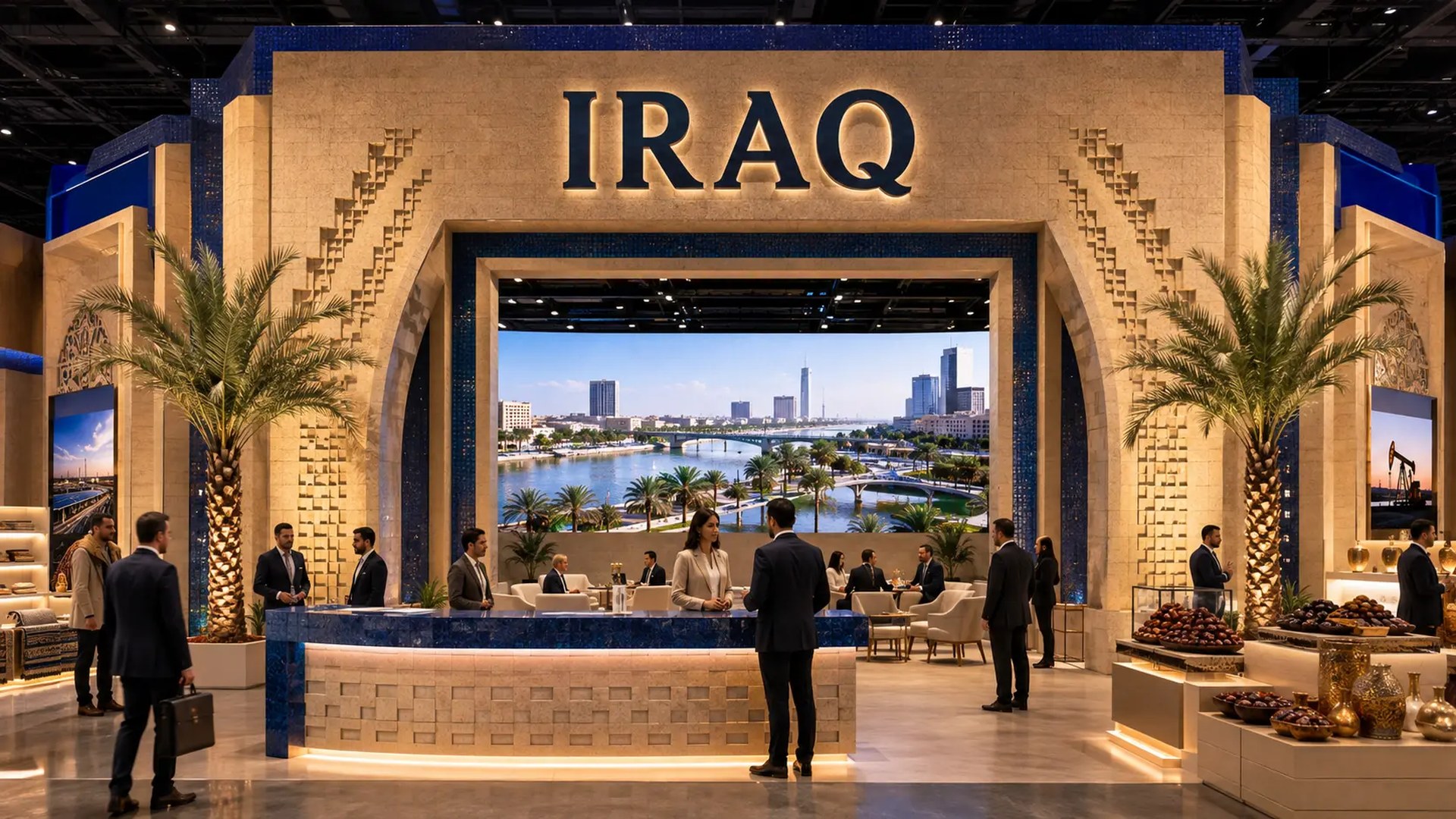
The Iraq pavilion connects American engineering, power and equipment firms with ministries and private contractors.
Sites inscribed on the UNESCO World Heritage List, a core part of the country's cultural and tourism offer.
The first capital of the Assyrian empire on the Tigris.
A fortified Parthian caravan city in the northern desert.
An Abbasid capital with the spiral Malwiya minaret.
A continuously inhabited mound at the heart of the Kurdistan Region.
The Mesopotamian marshes and the ancient cities of Ur, Uruk and Eridu.
The Neo-Babylonian capital on the Euphrates.
How companies from different markets can engage with Iraq through the Expo.
Bid on power, water and oilfield contracts, and appoint distributors for equipment and consumer brands.
Construction, building materials, food distribution and logistics into a 45-million-person market.
Upstream and gas-capture partnerships, the Development Road corridor and housing programmes.
Present your country's economy, industries, products, investment opportunities, tourism destinations and culture to the American and North American markets.
Reserve space in the Iraqi pavilion, or register as an American supplier to meet Iraqi buyers and contractors.
Last updated: August 2026