Anchor sector
Oil & gas services
Sonatrach's upstream and LNG programmes drive demand for drilling technology, compression, maintenance and digital field services.
 Profile content in preparation
Africa's largest country, Europe's gas neighbour.
The largest country in Africa by land area, a top global gas exporter, and a 46-million-person market opening steadily to foreign industrial partnership.
Statistics year: 2024 (latest full-year data)
Algeria holds some of the largest natural gas reserves in Africa and is a principal pipeline and LNG supplier to southern Europe, giving it substantial and stable export earnings.
The government is channelling that revenue into industrial localisation: pharmaceuticals, automotive assembly, steel, cement, fertilizers and food processing, with a strong preference for partners who manufacture domestically.
A 2022 investment law modernised the framework for foreign investors, removing the blanket local-majority requirement outside strategic sectors and creating a single investment agency.
Oil and gas dominate exports and public finances, while a deliberate localisation policy builds domestic manufacturing capacity.
Among the three largest African economies
Pipeline and LNG, mainly to Europe
A large domestic consumer market
Solar-led national programme
Sectors where Algerian state groups and private industrialists seek foreign technology, equipment and joint ventures.
Sonatrach's upstream and LNG programmes drive demand for drilling technology, compression, maintenance and digital field services.
A national policy to manufacture locally has built one of Africa's largest generics industries, seeking technology transfer partners.
Large-scale grain, dairy and Saharan agriculture projects requiring irrigation systems, machinery and processing lines.
The Gara Djebilet iron ore deposit and phosphate projects opening to international operators.
Multi-gigawatt solar tenders and green-hydrogen ambitions linked to European demand.
A relaunched framework for vehicle assembly and parts manufacturing with local-content requirements.
Algeria's policy agenda centres on raising non-hydrocarbon exports, substituting imports through domestic manufacturing and expanding renewables.
A modernised framework and a single investment agency (AAPI) for foreign investors.
Record non-oil exports as fertilizer, steel and cement capacity comes online.
First production from one of the world's largest untapped iron ore deposits.
15 GW of installed renewable capacity, predominantly solar.
Large state-led programmes with international supplier participation.
A giant western Saharan iron ore project with associated rail and processing infrastructure.
A long-planned pipeline linking Nigerian gas to Algeria and onward to Europe.
Multi-gigawatt utility-scale solar tenders across the high plateaus and the Sahara.
A planned deep-water container port west of Algiers designed as a regional transhipment hub.
Large irrigated farming concessions for cereals, oilseeds and sugar in the south.
The United States is a long-standing supplier of energy technology and agricultural commodities to Algeria, and American majors hold upstream positions in the country.
Verified full-year bilateral merchandise trade between Algeria and the United States, reported from Algeria's perspective.
Algeria records a goods surplus with the United States, based on hydrocarbon and fertilizer exports, while importing American grain, energy-sector machinery and pharmaceuticals.
These figures represent merchandise trade only and do not include services.
Statistical year: 2024
A vast and under-visited country with seven UNESCO World Heritage sites.
An Ottoman-era hilltop citadel above a French-colonial waterfront.
Two of the best-preserved Roman cities in North Africa.
A sandstone plateau with thousands of prehistoric rock paintings.
Five fortified 11th-century towns with distinctive architecture.
A Mediterranean port city and the home of raï music.
Scale, energy and a policy environment that rewards manufacturing on the ground.
Over 46 million consumers, the third-largest domestic market in the Arab world.
Among the lowest industrial gas and electricity prices in the world.
The 2022 framework removed the general 51/49 requirement outside strategic sectors.
AfCFTA membership plus land and sea routes into the Sahel and West Africa.
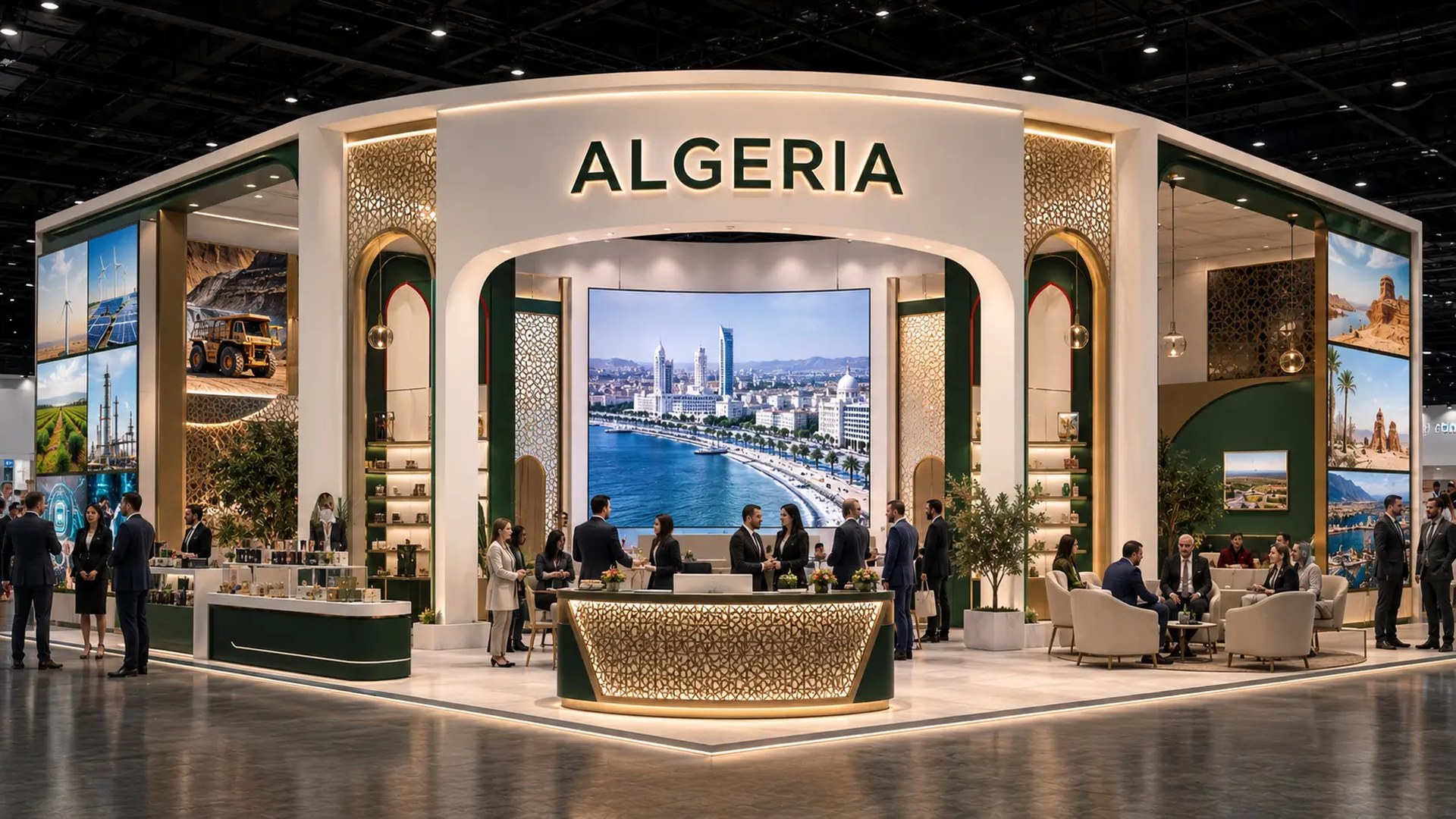
The Algeria pavilion focuses on industrial joint ventures, energy technology and agricultural supply.
Sites inscribed on the UNESCO World Heritage List, a core part of the country's cultural and tourism offer.
An Ottoman medina overlooking the Mediterranean.
A Roman colonial town founded by Trajan, laid out on a perfect grid.
A Roman mountain city adapted to steep terrain.
Phoenician, Roman and early Christian ruins on the coast.
One of the most important prehistoric rock-art collections in the world.
Five fortified Ibadi towns that influenced 20th-century architecture.
The ruined 11th-century capital of the Hammadid dynasty.
How companies from different markets can engage with Algeria through the Expo.
Supply oilfield technology, agricultural equipment and pharmaceutical technology transfer into a market that prioritises local production.
Joint ventures in food processing, construction materials and logistics serving a very large domestic market.
Mining concessions, solar tenders and the El Hamdania port programme offer large-ticket entry points.
Present your country's economy, industries, products, investment opportunities, tourism destinations and culture to the American and North American markets.
Reserve space in the Algerian pavilion, or register as an American supplier to meet Algerian state groups and industrialists.
Last updated: August 2026